Introduction
Tech giants envision future beyond smartphones as the defining narrative of 2025’s technological landscape. With global smartphone penetration hovering at 85% and shipments stagnating at around 1.2 billion units annually, the era of pocket-sized computing is giving way to more immersive, integrated experiences.
Thank you for reading this post, don’t forget to subscribe!Leaders like Apple, Google, Meta, and others are investing billions in alternatives that dissolve the boundaries between physical and digital worlds. This shift isn’t merely evolutionary; it’s revolutionary, promising to redefine productivity, social interaction, and daily life in profound ways.
The post-pandemic world has accelerated demands for contactless, hands-free tech, while AI’s maturation—evidenced by models like Gemini 2.0 and Llama 3—enables proactive, context-aware systems. Smartphones, once liberators, now feel constraining: endless scrolling contributes to mental health issues, with studies showing average daily screen time at 7 hours.
Battery anxiety, privacy breaches, and the physical toll of device dependency are pushing consumers toward ambient intelligence, where tech anticipates needs without demanding attention.
Tech giants envision future beyond smartphones through a mosaic of innovations: lightweight AR glasses projecting holograms, neural interfaces reading thoughts, and IoT ecosystems orchestrating homes. Apple’s upgraded Vision Pro, Google’s Beam for 3D calls, and Meta’s Orion prototypes exemplify this pivot.
The stakes are enormous—the ambient computing market alone is projected to reach $243 billion by year’s end, growing at 25.6% CAGR. Yet, ethical dilemmas like data sovereignty and digital divides loom, requiring balanced innovation.
This article delves into how tech giants envision future beyond smartphones, from key players to emerging tech, challenges, and bold 2030 forecasts. Whether you’re a tech enthusiast or business leader, understanding this transition equips you for a device-agnostic tomorrow. For broader context, explore our Tech category or Future tech trends.
Major Tech Giants Shaping the Post-Smartphone Era
Tech giants envision future beyond smartphones by channeling massive R&D into spatial and ambient paradigms, with over $100 billion invested collectively in 2025. Apple, Google, Meta, Microsoft, Amazon, and Samsung lead, each tailoring visions to their ecosystems while fostering interoperability.
Apple leads with Vision Pro’s 2025 refresh, featuring the M5 chip for faster rendering and extended battery life. CEO Tim Cook describes this as “spatial computing’s golden age,” where gestures and eye-tracking supplant taps.
Google launches Beam, AI-driven 3D conferencing transforming 2D feeds into immersive “light fields,” enabling eye contact and spatial audio without headsets.
Meta unveils Orion AR Glasses, projecting 3D interfaces onto reality with holographic social experiences.
Microsoft amplifies Azure Mixed Reality and Windows Mixed Reality Link for enterprise adoption.
Amazon expands Echo Frames (3rd Gen) with Alexa+ integration, forming ambient hubs with Astro robots.
Samsung focuses on Galaxy Ring updates, enhancing health tracking and AI-driven wellness features.
Cross-pollination accelerates: Google-HP partnerships and Apple-Meta talks on standards. Deloitte forecasts 39% AR/VR growth to 14 million units.
Pivotal Initiatives by Leading Companies
Table 1: Key Devices and Features
| Company | Upcoming Device/Initiative | Key Features | Launch Timeline | Target Market |
|---|---|---|---|---|
| Apple | Vision Pro 2 | M5 chip, 20% battery boost | Oct 2025 | Consumer/Enterprise |
| Beam | AI 3D video, light fields | Late 2025 | Business Collab | |
| Meta | Orion AR Glasses | 70° FOV holograms | Prototype 2025 | Social AR |
| Microsoft | Mixed Reality Link | Windows 11 in VR | GA Oct 2025 | Productivity |
| Amazon | Echo Frames 3rd Gen | Alexa+, prescription-ready | Now/Bundles | Daily Audio |
| Samsung | Galaxy Ring Update | ECG, mindfulness | H2 2025 | Health |
Emerging Technologies Beyond Smartphones
Tech giants envision future beyond smartphones via ambient computing and brain-computer interfaces (BCIs), blending tech into environments for intuitive use.
-
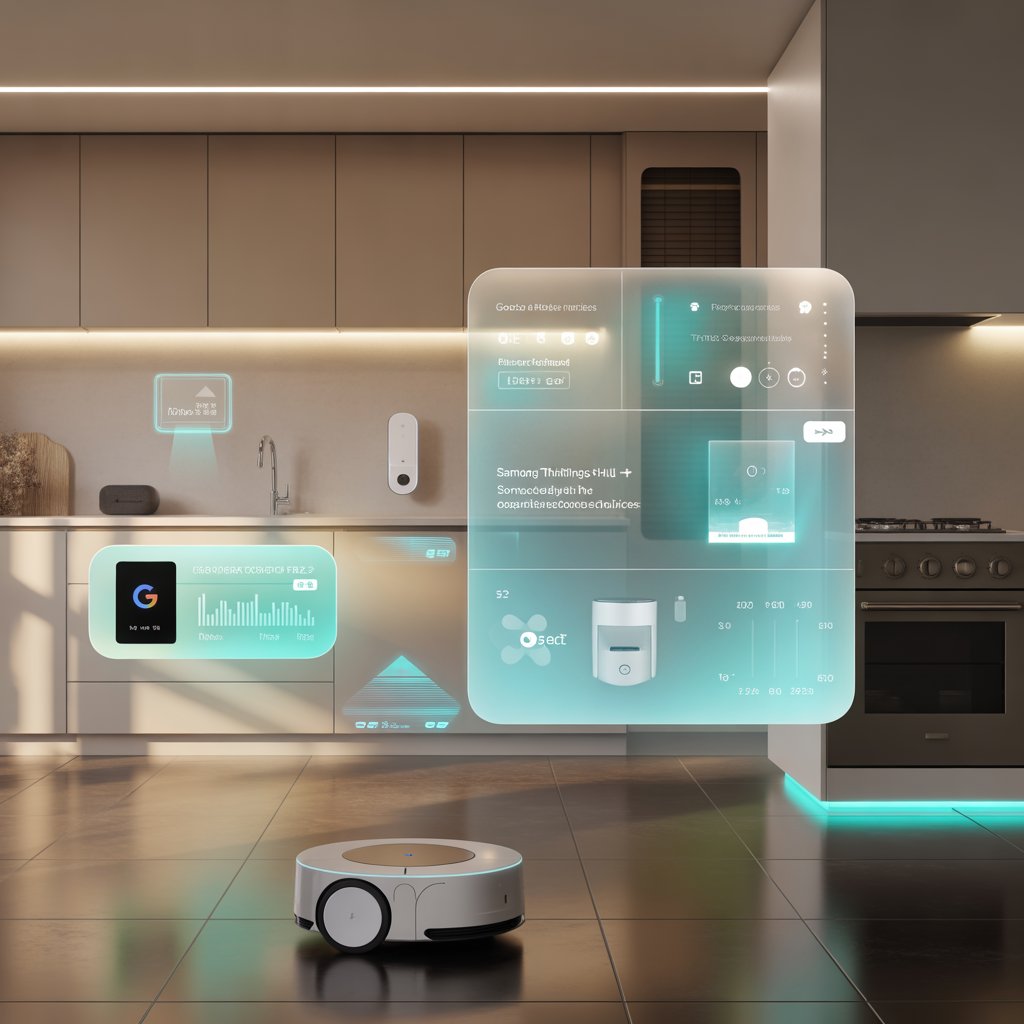
Ambient computing: AI embedded in surroundings predicts needs, e.g., Google Nest Hub Max preheats ovens based on calendar events, reducing energy use by 20%.
-
BCIs: Neuralink’s N1 Implant and Synchron devices advance thought-controlled interfaces.
-
Haptics & multi-sensory tech: Meta touch-suits, OVR olfactory devices enhance VR/AR immersion.
-
Edge AI & privacy: Local processing secures sensitive data.
Key Stats:
-
Ambient computing market: $59B in 2024 → $577B by 2034.
-
BCI implants: 12 in 2025.
-
Haptics CAGR: 25% through 2028.
Case Study: IKEA AR app with Vision Pro haptics increases purchase intent by 35%.
Explore Future tech trends for more.
Wearables Transforming Everyday Life
Wearables are at the forefront of the post-smartphone era. 136.5M units shipped in Q2 2025, a 9.6% YoY increase.
-
Samsung Galaxy Ring: Mindfulness tracking, ECG, device control via gestures.
-
Amazon Echo Frames (3rd Gen): Comfortable audio, hands-free Alexa integration.
-
Oura Gen4: 95% accurate cycle tracking, Apple Health integration.
Impact:
-
Health: Dexcom G7 alerts prevent 30% of hypo events.
-
Work: Whoop optimizes schedules, lifting output 15%.
-
Social: Humane Pin projects interfaces on skin.
Studies: Stanford (2025) shows 18% reduction in inactivity; Philips reports 28% improved sleep.
AR and VR Ecosystems of the Future

AR/VR shipments reached 14.3M in 2025, 39.2% growth.
-
Apple Vision Pro 2: 4K displays, Freeform app for collaboration.
-
Meta Orion: 70-inch FOV holograms, eye-tracking demos.
-
Google ARCore: Powers Beam overlays.
Use Cases: Boeing reduces errors by 90%, educational retention boosts 40%, healthcare AR market at $10.82B.
IoT and Smart Connected Devices
-
21.1B connected devices in 2025, 14% rise YoY.
-
Amazon Astro, Google Nest, Samsung SmartThings create smart homes.
-
Trends: Matter adoption 85%, energy optimization, smart cities.
-
EU regulations enforce opt-ins for privacy and consent.
AI and Machine Learning Driving Innovation
AI/ML drives post-smartphone ecosystems:
-
Google Gemini 2.0 agents: autonomous scheduling.
-
Apple Intelligence: overlay insights in Vision Pro.
-
Meta Llama: empathetic NPCs, real-time VR interactions.
Highlights:
-
95% edge AI for privacy.
-
Bias reduced 45% via audited models.
-
AutoML scaling, GenAI reshaping design.
Explore AI guides.
Quantum Computing and Next-Gen Processing
Quantum computing accelerates new tech possibilities:
-
IBM: 1,121-qubit processors, 120x faster drug simulations.
-
Google Willow (105 qubits) reduces errors.
-
Market impact: $250B by 2030.
Applications: logistics, crypto standards, climate simulations.
Challenges and Opportunities for Tech Giants
-
Challenges: AR costs >$1,000, battery tech limits, interoperability silos, privacy breaches +22%.
-
Opportunities: $3T ambient market, collaborative standards, AI ethics, modular wearables.
-
Adoption resistance: 45%, digital divide could widen 20%.
Predictions for 2030 and Beyond
Table 2: Forecasts for Key Technologies
| Technology | 2030 Projection | Impact |
|---|---|---|
| AR | 1.2B users | Holographic interfaces standard |
| AI | Therapist-level companions | Human assistance |
| IoT | 39B devices | Smart cities, automation |
| BCI | Neuralink telepathy | Direct brain-machine control |
| Quantum | Fault-tolerant processors | Simulation, logistics, crypto |
-
Neuralink enables telepathy, ambient AI handles 80% interactions.
-
IoT networks grow to 39B devices, autonomous urban management.
-
AR/VR, AI, and quantum tech converge to replace physical screens.
Conclusion: Key Takeaways and Future Outlook
2025 marks a pivotal shift: the smartphone yields to ambient AI, wearables, AR/VR, IoT, and quantum systems. Technology becomes intuitive, receding into daily life without distraction.
-
Wearables monitor health, productivity, and social connections.
-
BCIs and haptics create immersive, accessible experiences.
-
AI drives automation and predictive intelligence.
-
Equity, ethics, and sustainable practices are essential for adoption.
Actionable Advice:
-
Consumers: test Echo Frames or Vision Pro demos.
-
Professionals: audit AI readiness, integrate Mesh for Teams.
-
Policymakers: support trust regulations, quantum-safe encryption.
The post-smartphone era heralds liberation from notifications to augmented intuition. Stay updated via Tech category or explore Future tech trends.