
In today’s competitive business world, contracted out services—also known as outsourcing—offer companies a strategic way to streamline operations, cut costs, and access top-tier expertise. By leveraging external service providers, businesses can focus on innovation, growth, and operational efficiency, improving overall business scalability.
Thank you for reading this post, don’t forget to subscribe!Whether it’s IT support, payroll, marketing campaigns, or logistics, outsourcing allows companies to delegate non-core tasks to experts. For instance, integrating tools like AI-driven data automation into outsourced operations can further optimize workflows and save time.
What Are Contracted Out Services?
Contracted out services involve partnering with third-party vendors to handle tasks outside your company’s primary focus. This can include:
-
IT maintenance and cybersecurity
-
Human resources or payroll
-
Customer support
-
Marketing and creative services
These services can be short-term projects, like a one-off software development, or long-term partnerships for ongoing support. Formal contracts outline deliverables, timelines, and payments, ensuring accountability.
Outsourcing has evolved since the 1980s from manufacturing to knowledge-based services. Today, 92% of Global 2000 companies utilize some form of outsourcing, driven by digital transformation and the need for agility.
:max_bytes(150000):strip_icc()/TermDefinitions_Outsourcing-410e9120dbc44211a93c2716b883db05.jpg)
Types of Contracted Out Services
-
Business Process Outsourcing (BPO): Back-office tasks like accounting, data entry, or inventory tracking.
-
IT Outsourcing: Tech support, cybersecurity, or app development. Many businesses save 30–40% on IT costs.
-
Knowledge Process Outsourcing (KPO): Advanced work such as market analysis, legal research, and data analytics.
-
Manufacturing and Logistics: Outsourced production, shipping, and supply chain services for efficiency and scalability.
By outsourcing, companies access specialized skills without the overhead of hiring full-time employees.
Benefits of Contracted Out Services
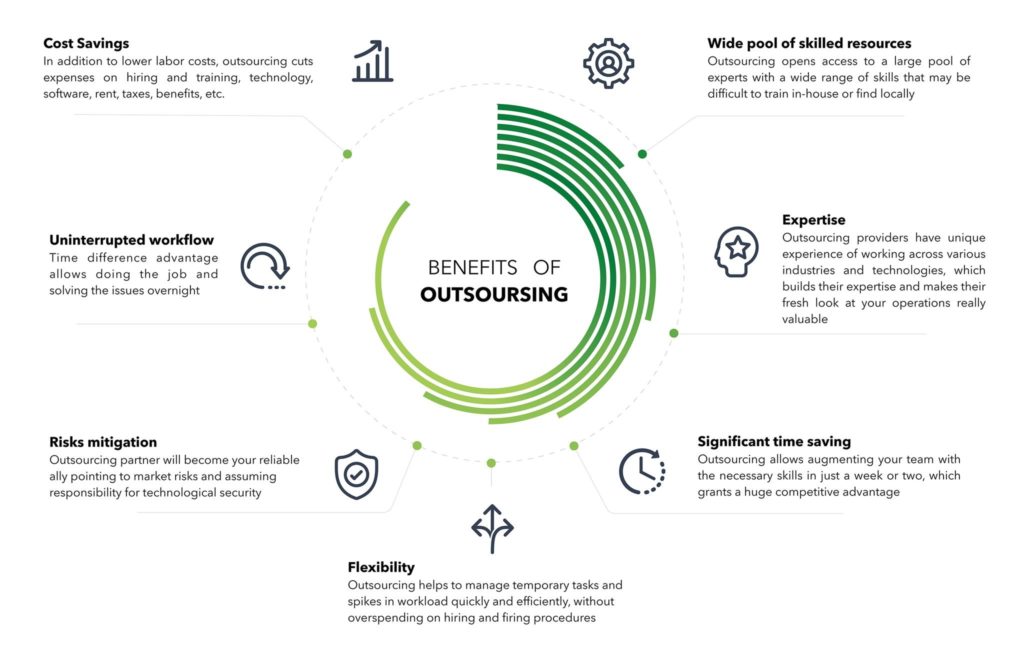
1. Cost Savings: Companies can reduce operational costs by up to 60% by outsourcing non-core tasks.
2. Access to Expertise: Outsourcing opens access to global specialists, from SEO experts to AI engineers see more on our AI solutions.
3. Flexibility and Scalability: Ramp operations up or down based on business needs without long-term commitments.
4. Focus on Core Competencies: Free internal teams to concentrate on strategic goals.
5. Risk Mitigation: Providers manage compliance, data protection, and industry regulations.
6. Innovation Boost: External partners introduce new technologies and creative solutions.
7. Time Efficiency: Quick project implementation compared to building in-house teams.
Comparison: In-House vs Contracted Out Services
| Aspect | In-House Operations | Contracted Out Services |
|---|---|---|
| Cost | High (salaries, benefits) | Lower (pay for service only) |
| Expertise | Limited to internal hires | Access to global specialists |
| Flexibility | Rigid scaling | Easy to adjust |
| Focus | Divided attention | Core business priority |
| Risk | Full liability | Shared with provider |
Risks and Mitigation
Outsourcing carries potential challenges, but careful planning reduces risks:
-
Loss of Control: Mitigate with clear contracts, KPIs, and frequent check-ins.
-
Data Security Risks: Use NDAs and trusted providers.
-
Communication Barriers: Choose vendors with strong English skills and collaboration tools.
-
Hidden Costs: Include transition fees in budgets.
-
Quality Issues: Start with small pilot projects.
-
Vendor Dependency: Diversify providers.
-
Employee Morale: Maintain transparent communication.
How to Implement Contracted Out Services
-
Assess Needs: Identify which tasks are suitable for outsourcing.
-
Research Providers: Check track records, reviews, and case studies.
-
Define Scope and Contract: Include SLAs, deliverables, and IP rights.
-
Select and Onboard: Start with trial projects to test quality.
-
Monitor and Optimize: Track performance, review KPIs, and adjust workflows.
Real-World Examples
-
City of Weston, Florida: Outsourced municipal services, cutting costs significantly.
-
Slack: IT outsourcing enabled rapid scaling and improved efficiency by 25%.
-
Healthcare Provider: Outsourced billing reduced errors by 50% and freed staff for patient care.
-
Manufacturing Firm: Outsourced logistics cut delivery times by 30%, enhancing customer satisfaction.
Legal Considerations
-
Ensure data protection compliance (GDPR, CCPA).
-
Clarify intellectual property rights in contracts.
-
Verify adherence to employment laws.
-
Include termination clauses and liability coverage.
FAQs
Q: Can small businesses use contracted services?
A: Yes, outsourcing is accessible for businesses of all sizes.
Q: How much can I save?
A: Up to 60%, depending on industry and scope.
Q: How long does implementation take?
A: Typically 1–3 months.
Q: What are the main risks?
A: Loss of control, security breaches, and hidden costs. Mitigation is possible with proper planning.
Conclusion
Contracted out services empower businesses to reduce costs, access expertise, and scale efficiently. Start with one non-core function, pilot a provider, and expand gradually. Proper contracts, performance monitoring, and vendor diversification ensure outsourcing drives measurable business growth.
To explore more about outsourcing solutions and business automation, check AI-driven data automation on DataDroped.