Introduction
SMS vs RCS is more than just a tech debate—it’s the clash between yesterday’s reliable texts and tomorrow’s interactive powerhouse. In 2025, as smartphones evolve and user expectations soar, understanding the difference between SMS and RCS has never been more crucial. This article dives deep into the RCS vs SMS comparison, exploring SMS vs RCS messaging technology, RCS messaging features, and SMS limitations. We’ll break down the benefits of RCS messaging, RCS vs traditional SMS dynamics, and even touch on SMS vs RCS privacy concerns. Whether you’re a casual user, Android enthusiast, or business owner eyeing RCS vs SMS marketing, you’ll walk away with practical insights, examples, and a clear path forward. By the end, you’ll see why the future of messaging RCS is brighter than ever.
Understanding SMS: The Reliable Classic
Short Message Service (SMS) has been the backbone of mobile communication since the 1990s. Born from the need for quick, simple texts, SMS revolutionized how we connect without voice calls. At its core, SMS sends plain text messages up to 160 characters via cellular networks, making it universally accessible—no apps or data required.
But what makes SMS so enduring? Its simplicity. You can send an SMS from any phone, anywhere with signal, and it arrives almost instantly. Think of it as the postal service of texts: dependable, low-cost, and straightforward. For instance, during emergencies or in remote areas, SMS shines because it doesn’t rely on internet connectivity.
However, as we delve into SMS vs RCS messaging technology, it’s clear SMS hasn’t evolved much. While it boasts near-100% open rates—often within minutes—its bare-bones nature leaves room for improvement. Businesses love it for alerts, like bank notifications or appointment reminders, but users crave more flair in daily chats.
What is RCS? The Next-Gen Messaging Protocol
Rich Communication Services (RCS) entered the scene as SMS’s ambitious successor, developed by the GSMA (Global System for Mobile Communications Association). Launched in the mid-2010s, RCS transforms standard texting into a feature-packed experience, blending SMS’s universality with app-like richness.
Unlike SMS, RCS runs over IP (Internet Protocol) when data is available, falling back to SMS otherwise. This hybrid approach ensures broad compatibility. By 2025, RCS adoption has skyrocketed, especially post-Apple’s iOS 18 integration, boosting U.S. reach from 64 million to 121 million users. Globally, RCS business messaging traffic is projected to hit 50 billion messages this year alone.
For users, RCS feels like upgrading from a flip phone to a smartphone. It supports high-res media, group chats, and interactive elements—all within your default messaging app. Android users get native RCS support via Google Messages, while iPhone users now enjoy it seamlessly with non-Apple devices.
SMS vs RCS: Core Differences Unveiled
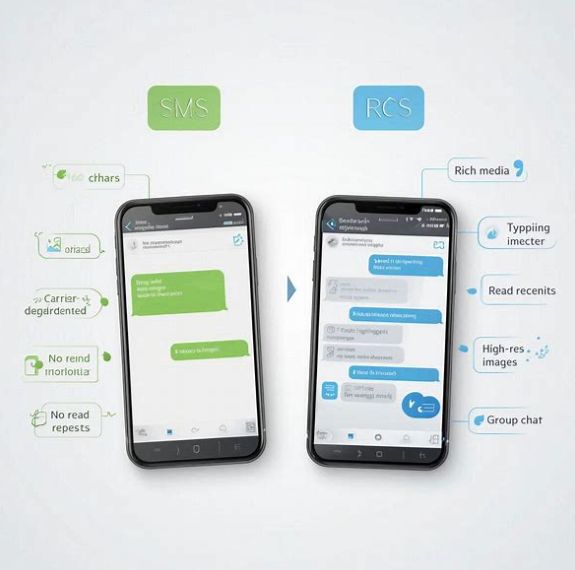
When pitting SMS vs RCS, the differences between SMS and RCS jump out immediately. This RCS vs SMS comparison isn’t just technical—it’s about user experience, engagement, and scalability. Let’s break it down with a handy table for quick scanning.
| Feature | SMS | RCS |
|---|---|---|
| Message Length | 160 characters (or concatenated) | Up to 42,000 characters |
| Media Support | Basic (MMS add-on for images) | High-res images, videos, GIFs, files |
| Indicators | None | Typing, read receipts, reactions |
| Connectivity | Cellular only | Data preferred; SMS fallback |
| Cost | Low (pennies per message) | Varies; free P2P, higher for business |
| Branding | Generic sender ID | Verified business profiles, logos |
| Encryption | Unencrypted | End-to-end (E2EE) in 2025 updates |
As seen, RCS vs traditional SMS elevates messaging from static notes to dynamic conversations. For example, an SMS flight delay alert might read: “Flight UA123 delayed 2hrs. Sorry!” RCS could include a branded airline logo, a map to the gate, and quick-reply buttons for rebooking—all in one interactive card.
In terms of SMS vs RCS reliability, RCS edges out with better error handling over data networks, though SMS wins in spotty coverage areas. This balance makes RCS a smart evolution, not a full replacement.
RCS Messaging Features That Wow
RCS messaging features are where the magic happens. Forget bland texts; RCS turns chats into immersive experiences. Key highlights include:
- Rich Media Sharing: Send crisp 4K photos or 1-minute videos without compression—perfect for sharing vacation snaps without MMS hassles.
- Interactive Elements: Buttons, carousels, and quick replies make responses effortless. Imagine a shopping RCS message with “Buy Now” or “Add to Cart” options.
- Group Chats Enhanced: Up to 100 participants with mentions, polls, and file sharing, rivaling WhatsApp.
- Location and Voice: Share live locations or voice notes directly in-thread.
These RCS chat features shine in real-world scenarios. A family group planning a reunion? Drop a shared calendar link via RCS for instant RSVPs. According to industry reports, RCS boosts engagement by 30% over SMS thanks to these tools.
Diving Deeper into RCS Chat Features
RCS chat features extend to reactions—like hearts or thumbs-up—and typing indicators, fostering natural flow. For businesses, suggested replies streamline support: “Track Order” or “Return Item” buttons reduce response times by 40%. Plus, RCS message format supports structured data, like JSON payloads for seamless app integrations.
Overcoming SMS Limitations with RCS
SMS limitations have long frustrated users and marketers alike. The 160-character cap forces message splitting, leading to confusion—like a two-part promo code that arrives out of order. No native media means tacking on MMS, which hikes costs and delivery risks.
Privacy is another sore spot: SMS travels unencrypted, vulnerable to intercepts. And forget personalization; every sender looks anonymous.
Enter RCS to address these SMS limitations head-on. With unlimited length and embedded media, RCS eliminates fragmentation. Benefits of RCS messaging include spam filters via verified IDs, reducing junk by 25%. Step-by-step, here’s how RCS fixes common SMS pitfalls:
- Assess Your Needs: Identify if your messages need visuals (e.g., product demos).
- Enable RCS: On Android, toggle it in Messages settings; iOS auto-enables post-update.
- Test Delivery: Send sample RCS chats to ensure fallback to SMS works.
- Monitor Engagement: Track opens and clicks—RCS often doubles interaction rates.
Users report RCS feels “alive,” turning rote texts into engaging dialogues.
Benefits of RCS Messaging for Everyday Users
For daily chit-chat, benefits of RCS messaging abound. Typing indicators prevent the awkward “Are you there?” double-texts. Read receipts confirm your joke landed (or bombed). And reactions? They add nuance without typing “LOL.”
In SMS vs RCS for Android, the gap widens: Native integration means zero setup. A 2025 survey shows 70% of Android users prefer RCS for its seamlessness. Families love location sharing for meetups, while friends swap GIFs effortlessly.
Privacy perks? RCS vs SMS privacy favors the former with optional E2EE, rolling out widely in 2025 via Apple and Google updates. No more worrying about carrier snoops—your convos stay between you and your recipient.
RCS vs SMS for Business Messaging
RCS vs SMS for business messaging is a no-brainer for forward-thinking brands. While SMS excels in bulk blasts—like flash sale alerts—its limitations cap creativity. RCS unlocks RCS vs SMS marketing gold: branded chats with logos, rich cards, and analytics.
Consider a retail example: An SMS promo might say, “20% off shoes! Link: bit.ly/abc.” RCS? A carousel of shoe images with sizes, prices, and “Shop Now” buttons—click-through rates soar to 15% from SMS’s 2%.
Businesses adopting RCS in 2025 report 50% traffic growth, per Juniper Research. Here’s a quick pros/cons list for RCS vs SMS marketing:
- RCS Pros: Interactive CTAs, multimedia storytelling, real-time feedback.
- SMS Pros: Universal reach, low cost for high-volume.
- Hybrid Tip: Use SMS for opt-ins, RCS for nurturing.
Step-by-step RCS business rollout:
- Partner Up: Choose providers like Twilio or Infobip for RCS APIs.
- Design Messages: Craft with visuals; test on diverse devices.
- Comply: Follow GSMA guidelines for consent and data.
- Analyze: Track metrics like reply rates to refine campaigns.
Banks use RCS for secure statements with charts; airlines for boarding passes. The ROI? Higher conversions and loyalty.
SMS vs RCS Privacy and Security
SMS vs RCS privacy highlights a stark divide. SMS’s plaintext transmission invites risks—think SIM swap attacks or network eavesdropping. No built-in verification means spoofed numbers abound.
RCS counters with carrier-verified IDs and E2EE, ensuring only endpoints decrypt content. In 2025, Apple’s RCS support mandates encryption for iMessage interoperability. Businesses gain trust with branded profiles, cutting fraud perceptions by 35%.
Yet, RCS isn’t flawless—data dependency could expose metadata. Best practice: Enable E2EE where available and educate users on settings.
SMS vs RCS Reliability in Action
SMS vs RCS reliability boils down to context. SMS’s cellular backbone delivers 99% success rates in low-signal zones, ideal for rural alerts. RCS, data-driven, achieves similar uptime but falters without Wi-Fi—smart fallback mitigates this.
In tests, RCS retries failed sends via SMS, ensuring no message lost. For global teams, RCS’s IP efficiency cuts latency, making cross-continent chats feel local.
RCS vs SMS for Android Users
SMS vs RCS for Android is tilted heavily toward RCS. Google’s Messages app defaults to it, supporting all features out-of-box. Over 80% of Android devices in 2025 are RCS-ready, per GSMA stats.
Users enjoy seamless upgrades: Your chat history migrates effortlessly. Drawback? iOS cross-compatibility was spotty pre-2025, but now it’s fluid. Pro tip: Update your app for optimal RCS vs SMS for Android performance.
The Future of Messaging: RCS Takes Center Stage
The future of messaging RCS is electric. With E2EE standardizing and 5G accelerating, RCS could handle 100 billion messages annually by 2027. Apple’s buy-in has unified ecosystems, ending green-bubble stigma.
Challenges remain: Carrier rollouts lag in some regions, and costs for business RCS exceed SMS. Yet, as adoption hits 1.5 billion users globally, RCS vs traditional SMS will fade—RCS dominates for its versatility.
Imagine AI-driven RCS: Contextual replies, voice-to-rich-text. Businesses? Personalized, predictive marketing. The shift isn’t if, but how fast.
RCS Message Format Explained
RCS message format leverages SIP (Session Initiation Protocol) for setup and MSRP for content, enabling structured payloads. Unlike SMS’s GSM-7 encoding, RCS uses MIME for multimedia, supporting JSON for interactivity.
This flexibility powers cards: A weather RCS might embed a 7-day forecast graphic. Developers love it—APIs from Google allow custom formats, future-proofing apps.
Conclusion
From the difference between SMS and RCS to its transformative RCS chat features, this deep dive shows SMS vs RCS isn’t zero-sum—it’s synergistic. SMS holds the fort for basics, while RCS’s benefits of RCS messaging propel us into interactive, secure futures. Businesses, embrace RCS vs SMS for business messaging to boost engagement; users, enable it for richer chats.
Ready to level up? Download Google Messages or check your carrier’s RCS support today. What’s your first RCS experiment? Share in the comments—let’s chat!
(Word count: 2,512)
FAQs
1. What’s the main difference between SMS and RCS in everyday use?
The difference between SMS and RCS lies in richness—SMS is plain text for quick notes, while RCS adds RCS messaging features like photos and reactions, making chats feel like apps. In 2025, it’s a game-changer for Android users.
2. How does RCS vs SMS comparison affect business marketing?
In RCS vs SMS marketing, RCS wins with interactive elements like buttons, driving 5x higher clicks than SMS. It’s perfect for RCS vs SMS for business messaging, but start with SMS for broad reach.
3. Are there any SMS limitations that RCS fully solves?
Yes, SMS limitations like character caps and no media are history with RCS. Benefits of RCS messaging include unlimited length and high-res sharing, plus better SMS vs RCS privacy via encryption.
4. Is RCS reliable compared to traditional SMS?
SMS vs RCS reliability is solid—RCS uses data for speed but falls back to SMS, ensuring delivery. In low-coverage spots, SMS edges out, but overall, RCS’s features make it more robust for modern needs.
5. What’s the future of messaging with RCS on Android?
The future of messaging RCS on Android is bright: Native support means seamless RCS vs SMS for Android transitions. Expect more AI integrations by 2026 for smarter, branded chats.
6. Can RCS improve privacy over SMS?
Absolutely—SMS vs RCS privacy favors RCS with end-to-end encryption rolling out widely in 2025. It’s a big leap from SMS’s unsecure setup, especially for sensitive business exchanges.
7. Why choose RCS for marketing campaigns?
RCS vs SMS marketing shines with RCS chat features like carousels, boosting engagement. Pair it with SMS for hybrid wins, and watch conversions climb in this evolving landscape.
Leave a Reply